MoreExam
1. Question Content...
EXPLANATION
Answer: X - EXPLANATION Content.
Question1: You are building an application that processes data files uploaded from thousands of suppliers. Your primary goals for the application are data security and the expiration of aged data. You need to design the application to:*Restrict access so that suppliers can access only their own data.*Give suppliers write access to data only for 30 minutes.*Delete data that is over 45 days old.You have a very short development cycle, and you need to make sure that the application requires minimal maintenance. Which two strategies should you use? (Choose two.)
Question2: Your finance team wants to view the billing report for your projects. You want to make sure that the finance team does not get additional permissions to the project. What should you do?
Question3: You manage three Google Cloud projects with the Cloud Monitoring API enabled. You want to follow Google-recommended practices to visualize CPU and network metrics for all three projects together. What should you do?
Question4: The storage costs for your application logs have far exceeded the project budget. The logs are currently being retained indefinitely in the Cloud Storage bucket myapp-gcp-ace-logs. You have been asked to remove logs older than 90 days from your Cloud Storage bucket. You want to optimize ongoing Cloud Storage spend.What should you do?
Question5: You want to configure autohealing for network load balancing for a group of Compute Engine instances that run in multiple zones, using the fewest possible steps. You need to configure re-creation of VMs if they are unresponsive after 3 attempts of 10 seconds each. What should you do?
Question6: Your company's infrastructure is on-premises, but all machines are running at maximum capacity. You want to burst to Google Cloud. The workloads on Google Cloud must be able to directly communicate to the workloads on-premises using a private IP range. What should you do?
Question7: Your company has a single sign-on (SSO) identity provider that supports Security Assertion Markup Language (SAML) integration with service providers. Your company has users in Cloud Identity. You would like users to authenticate using your company's SSO provider. What should you do?
Question8: You have a Compute Engine instance hosting a production application. You want to receive an email if the instance consumes more than 90% of its CPU resources for more than 15 minutes. You want to use Google services. What should you do?
Question9: Your company has a large quantity of unstructured data in different file formats. You want to perform ETL transformations on the data. You need to make the data accessible on Google Cloud so it can be processed by a Dataflow job. What should you do?
Question10: Your organization needs to grant users access to query datasets in BigQuery but prevent them from accidentally deleting the datasets. You want a solution that follows Google-recommended practices. What should you do?
Question11: Your company is moving from an on-premises environment to Google Cloud Platform (GCP). You have multiple development teams that use Cassandra environments as backend databases. They all need a development environment that is isolated from other Cassandra instances. You want to move to GCP quickly and with minimal support effort. What should you do?
Question12: Your company set up a complex organizational structure on Google Could Platform. The structure includes hundreds of folders and projects. Only a few team members should be able to view the hierarchical structure.You need to assign minimum permissions to these team members and you want to follow Google-recommended practices. What should you do?
Question13: You created a Kubernetes deployment by running kubectl run nginx image=nginx replicas=1. After a few days, you decided you no longer want this deployment. You identified the pod and deleted it by running kubectl delete pod. You noticed the pod got recreated.$ kubectl get podsNAME READY STATUS RESTARTS AGEnginx-84748895c4-nqqmt 1/1 Running 0 9m41s$ kubectl delete pod nginx-84748895c4-nqqmtpod nginx-84748895c4-nqqmt deleted$ kubectl get podsNAME READY STATUS RESTARTS AGEnginx-84748895c4-k6bzl 1/1 Running 0 25sWhat should you do to delete the deployment and avoid pod getting recreated?
Question14: You created a Google Cloud Platform project with an App Engine application inside the project. You initially configured the application to be served from the us-central region. Now you want the application to be served from the asia-northeast1 region. What should you do?
Question15: You have deployed an application on a single Compute Engine instance. The application writes logs to disk.Users start reporting errors with the application. You want to diagnose the problem. What should you do?
Question16: You have designed a solution on Google Cloud Platform (GCP) that uses multiple GCP products. Your company has asked you to estimate the costs of the solution. You need to provide estimates for the monthly total cost. What should you do?
Question17: Your company has an internal application for managing transactional orders. The application is used exclusively by employees in a single physical location. The application requires strong consistency, fast queries, and ACID guarantees for multi-table transactional updates. The first version of the application is implemented inPostgreSQL, and you want to deploy it to the cloud with minimal code changes. Which database is most appropriate for this application?
Question18: The sales team has a project named Sales Data Digest that has the ID acme-data-digest You need to set up similar Google Cloud resources for the marketing team but their resources must be organized independently of the sales team. What should you do?
Question19: You created several resources in multiple Google Cloud projects. All projects are linked to different billing accounts. To better estimate future charges, you want to have a single visual representation of all costs incurred. You want to include new cost data as soon as possible. What should you do?
Question20: You need to select and configure compute resources for a set of batch processing jobs. These jobs take around2 hours to complete and are run nightly. You want to minimize service costs. What should you do?
Question21: You need to enable traffic between multiple groups of Compute Engine instances that are currently running two different GCP projects. Each group of Compute Engine instances is running in its own VPC. What should you do?
Question22: A team of data scientists infrequently needs to use a Google Kubernetes Engine (GKE) cluster that you manage. They require GPUs for some long-running, non-restartable jobs. You want to minimize cost. What should you do?
Question23: You are configuring service accounts for an application that spans multiple projects. Virtual machines (VMs) running in the web-applications project need access to BigQuery datasets in crm-databases-proj. You want to follow Google-recommended practices to give access to the service account in the web-applications project.What should you do?
Question24: You are the team lead of a group of 10 developers. You provided each developer with an individual Google Cloud Project that they can use as their personal sandbox to experiment with different Google Cloud solutions.You want to be notified if any of the developers are spending above $500 per month on their sandbox environment. What should you do?
Question25: Your company runs its Linux workloads on Compute Engine instances. Your company will be working with a new operations partner that does not use Google Accounts. You need to grant access to the instances to your operations partner so they can maintain the installed tooling. What should you do?
Question26: You have downloaded and installed the gcloud command line interface (CLI) and have authenticated with your Google Account. Most of your Compute Engine instances in your project run in the europe-west1-d zone.You want to avoid having to specify this zone with each CLI command when managing these instances. What should you do?
Question27: You are performing a monthly security check of your Google Cloud environment and want to know who has access to view data stored in your Google Cloud Project. What should you do?
Question28: You need to reduce GCP service costs for a division of your company using the fewest possible steps. You need to turn off all configured services in an existing GCP project. What should you do?
Question29: You have a Linux VM that must connect to Cloud SQL. You created a service account with the appropriate access rights. You want to make sure that the VM uses this service account instead of the default Compute Engine service account. What should you do?
Question30: You have created a new project in Google Cloud through the gcloud command line interface (CLI) and linked a billing account. You need to create a new Compute Engine instance using the CLI. You need to perform the prerequisite steps. What should you do?
Question31: You want to verify the IAM users and roles assigned within a GCP project named my-project. What should you do?
Question32: Your organization has strict requirements to control access to Google Cloud projects. You need to enable your Site Reliability Engineers (SREs) to approve requests from the Google Cloud support team when an SRE opens a support case. You want to follow Google-recommended practices. What should you do?
Question33: Your organization has a dedicated person who creates and manages all service accounts for Google Cloud projects. You need to assign this person the minimum role for projects. What should you do?
Question34: You are developing a new application and are looking for a Jenkins installation to build and deploy your source code. You want to automate the installation as quickly and easily as possible. What should you do?
Question35: You have a large 5-TB AVRO file stored in a Cloud Storage bucket. Your analysts are proficient only in SQL and need access to the data stored in this file. You want to find a cost-effective way to complete their request as soon as possible. What should you do?
Question36: Your company developed an application to deploy on Google Kubernetes Engine. Certain parts of the application are not fault-tolerant and are allowed to have downtime Other parts of the application are critical and must always be available. You need to configure a Goorj e Kubernfl:es Engine duster while optimizing for cost. What should you do?
Question37: You want to configure an SSH connection to a single Compute Engine instance for users in the dev1 group.This instance is the only resource in this particular Google Cloud Platform project that the dev1 users should be able to connect to. What should you do?
Question38: Your company has developed a new application that consists of multiple microservices. You want to deploy the application to Google Kubernetes Engine (GKE), and you want to ensure that the cluster can scale as more applications are deployed in the future. You want to avoid manual intervention when each new application is deployed. What should you do?
Question39: You built an application on your development laptop that uses Google Cloud services. Your application uses Application Default Credentials for authentication and works fine on your development laptop. You want to migrate this application to a Compute Engine virtual machine (VM) and set up authentication using Google- recommended practices and minimal changes. What should you do?
Question40: You are managing several Google Cloud Platform (GCP) projects and need access to all logs for the past 60 days. You want to be able to explore and quickly analyze the log contents. You want to follow Google- recommended practices to obtain the combined logs for all projects. What should you do?
Question41: You created an instance of SQL Server 2017 on Compute Engine to test features in the new version. You want to connect to this instance using the fewest number of steps. What should you do?
Question42: You are designing an application that lets users upload and share photos. You expect your application to grow really fast and you are targeting a worldwide audience. You want to delete uploaded photos after 30 days. You want to minimize costs while ensuring your application is highly available. Which GCP storage solution should you choose?
Question43: You need to create a custom IAM role for use with a GCP service. All permissions in the role must be suitable for production use. You also want to clearly share with your organization the status of the custom role. This will be the first version of the custom role. What should you do?
Question44: You want to select and configure a solution for storing and archiving data on Google Cloud Platform. You need to support compliance objectives for data from one geographic location. This data is archived after 30 days and needs to be accessed annually. What should you do?
Question45: You need to create a custom VPC with a single subnet. The subnet's range must be as large as possible. Which range should you use?
Question46: You have been asked to create robust Virtual Private Network (VPN) connectivity between a new Virtual Private Cloud (VPC) and a remote site. Key requirements include dynamic routing, a shared address space of10.19.0.1/22, and no overprovisioning of tunnels during a failover event. You want to follow Google-recommended practices to set up a high availability Cloud VPN. What should you do?
Question47: Your company has multiple projects linked to a single billing account in Google Cloud. You need to visualize the costs with specific metrics that should be dynamically calculated based on company-specific criteria. You want to automate the process. What should you do?
Question48: You are deploying an application to App Engine. You want the number of instances to scale based on request rate. You need at least 3 unoccupied instances at all times. Which scaling type should you use?
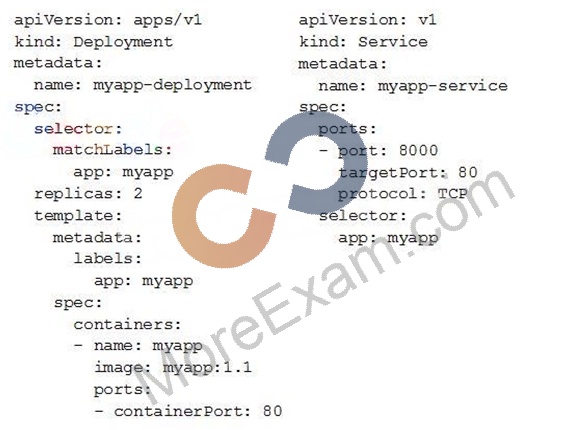
Question49: You deployed a new application inside your Google Kubernetes Engine cluster using the YAML file specified below.You check the status of the deployed pods and notice that one of them is still in PENDING status:You want to find out why the pod is stuck in pending status. What should you do?
Question50: You need to provide a cost estimate for a Kubernetes cluster using the GCP pricing calculator for Kubernetes.Your workload requires high IOPs, and you will also be using disk snapshots. You start by entering the number of nodes, average hours, and average days. What should you do next?
Question51: You are developing a financial trading application that will be used globally. Data is stored and queried using a relational structure, and clients from all over the world should get the exact identical state of the data. The application will be deployed in multiple regions to provide the lowest latency to end users. You need to select a storage option for the application data while minimizing latency. What should you do?
Question52: You have a Dockerfile that you need to deploy on Kubernetes Engine. What should you do?
Question53: You have a web application deployed as a managed instance group. You have a new version of the application to gradually deploy. Your web application is currently receiving live web traffic. You want to ensure that the available capacity does not decrease during the deployment. What should you do?
Question54: Several employees at your company have been creating projects with Cloud Platform and paying for it with their personal credit cards, which the company reimburses. The company wants to centralize all these projects under a single, new billing account. What should you do?
Question55: You have successfully created a development environment in a project for an application. This application uses Compute Engine and Cloud SQL. Now, you need to create a production environment for this application.The security team has forbidden the existence of network routes between these 2 environments, and asks you to follow Google-recommended practices. What should you do?
Question56: You are building a new version of an application hosted in an App Engine environment. You want to test the new version with 1% of users before you completely switch your application over to the new version. What should you do?
Question57: You need to deploy an application in Google Cloud using savorless technology. You want to test a new version of the application with a small percentage of production traffic. What should you do?
Question58: You have two subnets (subnet-a and subnet-b) in the default VPC. Your database servers are running in subnet- a. Your application servers and web servers are running in subnet-b. You want to configure a firewall rule that only allows database traffic from the application servers to the database servers. What should you do?
Question59: You are hosting an application from Compute Engine virtual machines (VMs) in us-central1-a. You want to adjust your design to support the failure of a single Compute Engine zone, eliminate downtime, and minimize cost. What should you do?
Question60: An employee was terminated, but their access to Google Cloud Platform (GCP) was not removed until 2 weeks later. You need to find out this employee accessed any sensitive customer information after their termination. What should you do?
Question61: You want to add a new auditor to a Google Cloud Platform project. The auditor should be allowed to read, but not modify, all project items.How should you configure the auditor's permissions?
Question62: Your management has asked an external auditor to review all the resources in a specific project. The security team has enabled the Organization Policy called Domain Restricted Sharing on the organization node by specifying only your Cloud Identity domain. You want the auditor to only be able to view, but not modify, the resources in that project. What should you do?
Question63: You want to set up a Google Kubernetes Engine cluster Verifiable node identity and integrity are required for the cluster, and nodes cannot be accessed from the internet. You want to reduce the operational cost of managing your cluster, and you want to follow Google-recommended practices. What should you do?
Question64: You have experimented with Google Cloud using your own credit card and expensed the costs to your company. Your company wants to streamline the billing process and charge the costs of your projects to their monthly invoice. What should you do?
Question65: Your development team needs a new Jenkins server for their project. You need to deploy the server using the fewest steps possible. What should you do?
Question66: You have a website hosted on App Engine standard environment. You want 1% of your users to see a new test version of the website. You want to minimize complexity. What should you do?
Question67: You are assisting a new Google Cloud user who just installed the Google Cloud SDK on their VM. The server needs access to Cloud Storage. The user wants your help to create a new storage bucket. You need to make this change in multiple environments. What should you do?
Question68: You will have several applications running on different Compute Engine instances in the same project. You want to specify at a more granular level the service account each instance uses when calling Google Cloud APIs. What should you do?
Question69: Your organization has strict requirements to control access to Google Cloud projects. You need to enable your Site Reliability Engineers (SREs) to approve requests from the Google Cloud support team when an SRE opens a support case. You want to follow Google-recommended practices. What should you do?
Question70: You have one GCP account running in your default region and zone and another account running in a non-default region and zone. You want to start a new Compute Engine instance in these two Google Cloud Platform accounts using the command line interface. What should you do?
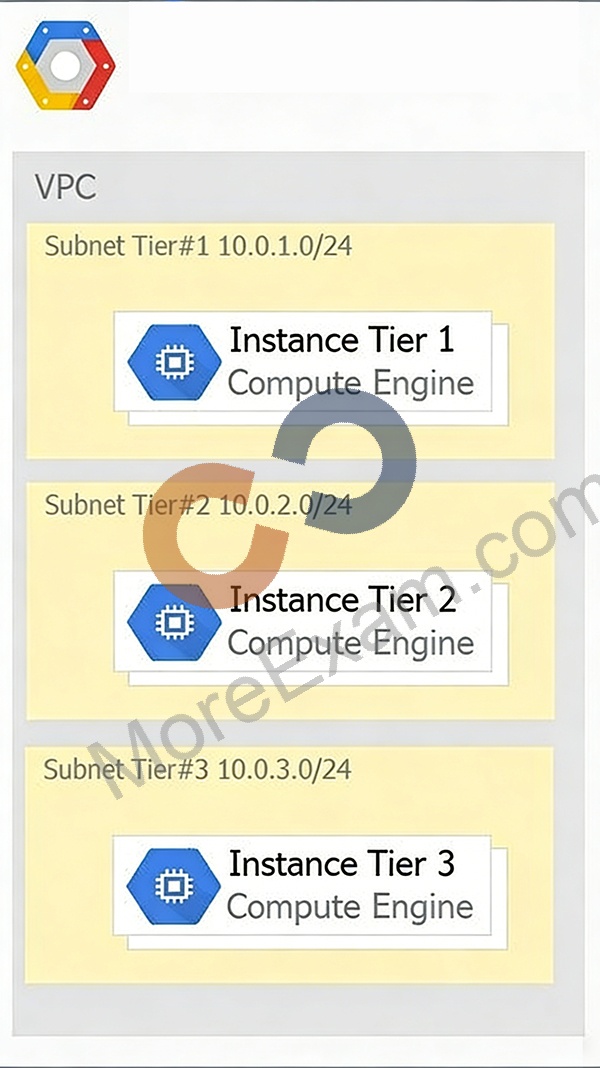
Question71: Your company has a 3-tier solution running on Compute Engine. The configuration of the current infrastructure is shown below.Each tier has a service account that is associated with all instances within it. You need to enable communication on TCP port 8080 between tiers as follows:* Instances in tier #1 must communicate with tier #2.* Instances in tier #2 must communicate with tier #3.What should you do?
Question72: You have created a code snippet that should be triggered whenever a new file is uploaded to a Cloud Storage bucket. You want to deploy this code snippet. What should you do?
Question73: You are working with a user to set up an application in a new VPC behind a firewall. The user is concerned about data egress. You want to configure the fewest open egress ports. What should you do?
Question74: You are working with a Cloud SQL MySQL database at your company. You need to retain a month-end copy of the database for three years for audit purposes. What should you do?
Question75: You have been asked to set up Object Lifecycle Management for objects stored in storage buckets. The objects are written once and accessed frequently for 30 days. After 30 days, the objects are not read again unless there is a special need. The object should be kept for three years, and you need to minimize cost. What should you do?
Question76: You deployed an App Engine application using gcloud app deploy, but it did not deploy to the intended project. You want to find out why this happened and where the application deployed. What should you do?
Question77: You are assigned to maintain a Google Kubernetes Engine (GKE) cluster named dev that was deployed on Google Cloud. You want to manage the GKE configuration using the command line interface (CLI). You have just downloaded and installed the Cloud SDK. You want to ensure that future CLI commands by default address this specific cluster. What should you do?
Question78: You have a number of applications that have bursty workloads and are heavily dependent on topics to decouple publishing systems from consuming systems. Your company would like to go serverless to enable developers to focus on writing code without worrying about infrastructure. Your solution architect has already identified Cloud Pub/Sub as a suitable alternative for decoupling systems. You have been asked to identify a suitable GCP Serverless service that is easy to use with Cloud Pub/Sub. You want the ability to scale down to zero when there is no traffic in order to minimize costs. You want to follow Google recommended practices.What should you suggest?
Question79: You have a batch workload that runs every night and uses a large number of virtual machines (VMs). It is fault- tolerant and can tolerate some of the VMs being terminated. The current cost of VMs is too high. What should you do?
Question80: You are creating an application that will run on Google Kubernetes Engine. You have identified MongoDB as the most suitable database system for your application and want to deploy a managed MongoDB environment that provides a support SLA. What should you do?
Question81: You need to monitor resources that are distributed over different projects in Google Cloud Platform. You want to consolidate reporting under the same Stackdriver Monitoring dashboard. What should you do?
Question82: You significantly changed a complex Deployment Manager template and want to confirm that the dependencies of all defined resources are properly met before committing it to the project. You want the most rapid feedback on your changes. What should you do?
Question83: For analysis purposes, you need to send all the logs from all of your Compute Engine instances to a BigQuery dataset called platform-logs. You have already installed the Stackdriver Logging agent on all the instances.You want to minimize cost. What should you do?
Question84: Your company wants to standardize the creation and management of multiple Google Cloud resources using Infrastructure as Code. You want to minimize the amount of repetitive code needed to manage the environment What should you do?
Question85: You want to select and configure a cost-effective solution for relational data on Google Cloud Platform. You are working with a small set of operational data in one geographic location. You need to support point-in-time recovery. What should you do?
Question86: You have one project called proj-sa where you manage all your service accounts. You want to be able to use a service account from this project to take snapshots of VMs running in another project called proj-vm. What should you do?
Question87: You want to find out when users were added to Cloud Spanner Identity Access Management (IAM) roles on your Google Cloud Platform (GCP) project. What should you do in the GCP Console?
Question88: You have an application that receives SSL-encrypted TCP traffic on port 443. Clients for this application are located all over the world. You want to minimize latency for the clients. Which load balancing option should you use?
Question89: Your company runs one batch process in an on-premises server that takes around 30 hours to complete. The task runs monthly, can be performed offline, and must be restarted if interrupted. You want to migrate this workload to the cloud while minimizing cost. What should you do?
Question90: Your company publishes large files on an Apache web server that runs on a Compute Engine instance. The Apache web server is not the only application running in the project. You want to receive an email when the egress network costs for the server exceed 100 dollars for the current month as measured by Google Cloud Platform (GCP). What should you do?
Question91: Your company uses a large number of Google Cloud services centralized in a single project. All teams have specific projects for testing and development. The DevOps team needs access to all of the production services in order to perform their job. You want to prevent Google Cloud product changes from broadening their permissions in the future. You want to follow Google-recommended practices. What should you do?
Question92: You are designing an application that uses WebSockets and HTTP sessions that are not distributed across the web servers. You want to ensure the application runs properly on Google Cloud Platform. What should you do?
Question93: You have sensitive data stored in three Cloud Storage buckets and have enabled data access logging. You want to verify activities for a particular user for these buckets, using the fewest possible steps. You need to verify the addition of metadata labels and which files have been viewed from those buckets. What should you do?
Question94: Your company is using Google Workspace to manage employee accounts. Anticipated growth will increase the number of personnel from 100 employees to 1.000 employees within 2 years. Most employees will need access to your company's Google Cloud account. The systems and processes will need to support 10x growth without performance degradation, unnecessary complexity, or security issues. What should you do?
Question95: You have deployed multiple Linux instances on Compute Engine. You plan on adding more instances in the coming weeks. You want to be able to access all of these instances through your SSH client over me Internet without having to configure specific access on the existing and new instances. You do not want the Compute Engine instances to have a public IP. What should you do?
Question96: Your company uses Cloud Storage to store application backup files for disaster recovery purposes. You want to follow Google's recommended practices. Which storage option should you use?
Question97: You need to produce a list of the enabled Google Cloud Platform APIs for a GCP project using the gcloud command line in the Cloud Shell. The project name is my-project. What should you do?
Question98: You need to configure optimal data storage for files stored in Cloud Storage for minimal cost. The files are used in a mission-critical analytics pipeline that is used continually. The users are in Boston, MA (United States). What should you do?
Question99: You have developed an application that consists of multiple microservices, with each microservice packaged in its own Docker container image. You want to deploy the entire application on Google Kubernetes Engine so that each microservice can be scaled individually. What should you do?